


Dear Readers:
It’s back.
Just like clockwork. Just like it does twice a year, frustrating the American population (as well as causing some serious problems).
The vast majority agree: We ought to stop this unnecessary routine.
But there’s a big problem: We can’t agree on how.
Which way should we “lock the clock?”
This debate about Daylight Savings Time (DST) is back. And it’s not going to stop until we can agree.
Can we?
I’m not so sure because the two sides are entrenched. I’ve got my own preference as well, as you’ll see. In addition, though, I offer some new perspectives on this debate…
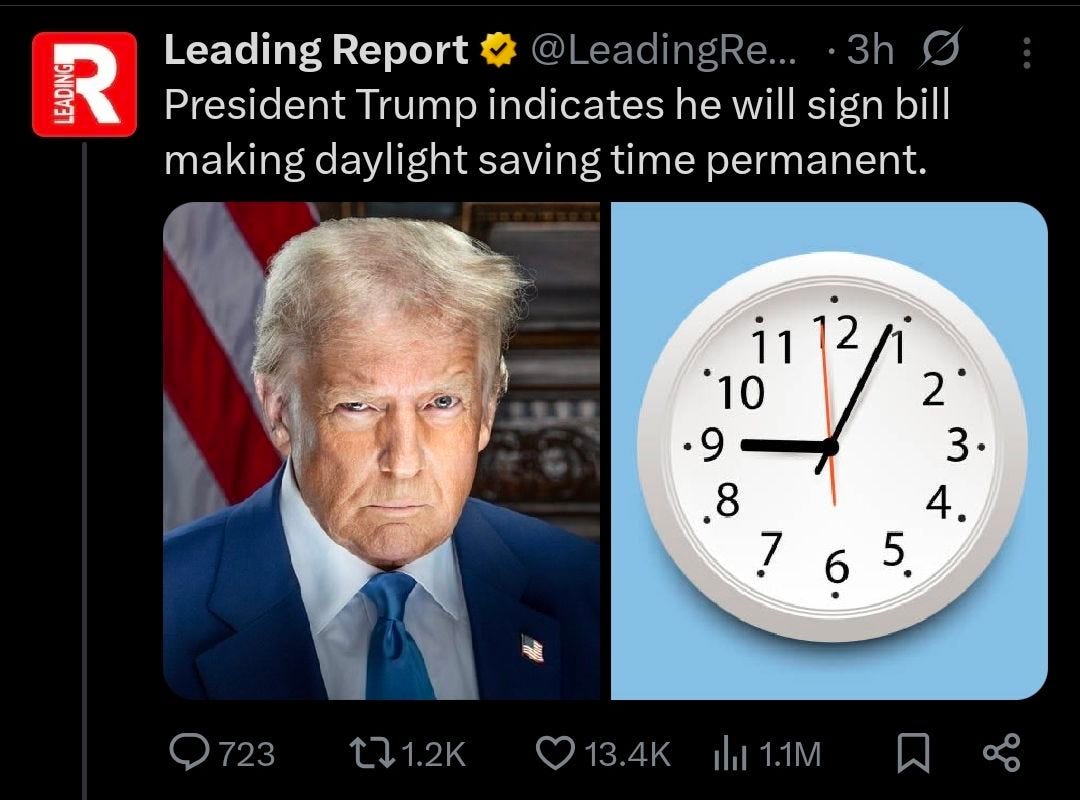
This announcement Monday catapulted this issue back to the top of X and other social media. Between all the posts there, my own post on Facebook, and some general observations, I’ve assessed that those supporting permanent Daylight Saving Time—light later in the day—outnumber those who favor Standard Time. Perhaps it's a 60/40 split.
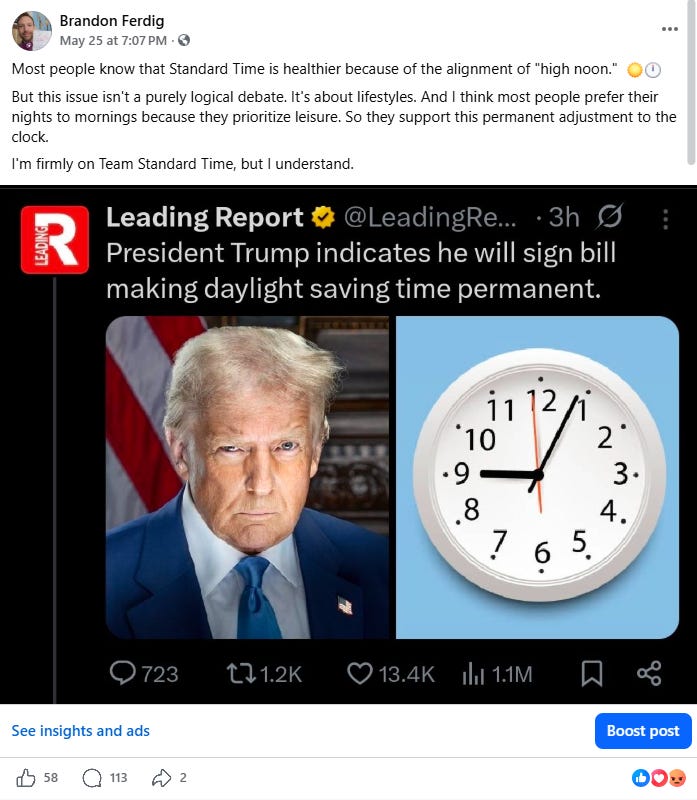
My post on Facebook above shows more comments than “likes,” with most disagreeing with my preference for Standard Time. Similarly, the post from X below is typical, with many others like it expressing a desire for Standard Time but also containing high numbers of comments disagreeing.
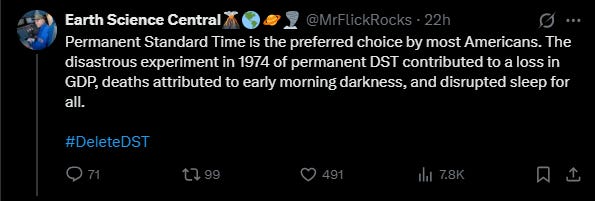
A majority of Americans prefer DST, I believe, because most live a life prioritizing the later hours of the day.
This is an issue about lifestyle.
This majority is made up of those eager to get through the day and enjoy that which is waiting for them after their job: family, recreation, etc. More sunlight during this time is welcome. Sunlight being a finite resource, one man even wrote that it’s “wasted” in the morning.
“Wasted?” I thought. “But these are our sharpest, freshest, most productive hours for our bodies and mind. Wouldn’t we want more sunlight then?”
This is the divide.
I don’t have kids to play with after school. I’m not much of a night owl or a partier. My creative batteries run out throughout the day. So, I try to embrace the mornings when I can best work on my stories and other projects fully charged following a night’s sleep.
I always remembered what Mom told me, repeating the Ben Franklin saying:
“Early to bed and early to rise
makes a man healthy, wealthy, and wise.”
I think the general truth applies especially for any craftsperson, entrepreneur, creative, or leader of any kind. And if I was a father, I’d prefer earlier sun as a model for my kids to learn and embrace themselves. Leisure hours are precious, but they don’t demand as much. To be our best when more is demanded, we prioritize the mornings.
And to be our best—at all hours of the day—we align ourselves with the more natural sleep-wake cycle established over millennia.
According to Google, here’s a rundown of the medical argument for Standard Time:
“Medical consensus strongly favors permanent Standard Time because it aligns closer to natural human biology. Here are the primary health benefits:
“Better Sleep Quality: Standard Time provides more morning light, which naturally resets your circadian rhythm, making it easier to wake up and fall asleep at night. Permanent Daylight Saving Time (DST) causes chronic sleep deprivation by forcing people to wake up in the dark.
“Lower Cardiovascular Risks: Moving to permanent DST is linked to increased rates of heart attacks, strokes, and irregular heartbeats due to chronic sleep disruptions. Standard Time mitigates these cardiovascular stresses.
“Improved Mental Health: Increased morning sunlight boosts serotonin levels and reduces the risks of seasonal affective disorder (SAD), depression, and anxiety.
“Reduced Accidents: Studies show that regular sleep schedules under Standard Time lead to better alertness, fewer workplace injuries, and a reduction in fatal traffic accidents compared to the grogginess associated with DST.”
Reading all this, it initially seems odd anyone would prefer Daylight Saving Time. But the effects aren’t huge. And, according to one person commenting on Facebook, he prefers daylight later in the day when he actually “lives his life.”
It’s hard to argue with that.
Yet, I do think permanent DST is a mistake.
So, the way I see it: A strong manager can make the policy decision that, despite being unpopular with employees, proves to be better for the organization. DST vs Standard Time is one of these decisions for America.
Daylight Saving Time, I think, has always been a policy typical of government meddling with nature or the economy to the long-term detriment of the whole.
It's reminiscent of how America prints money.
"Let's print off a bunch more money. That'll solve our resource issue."
We do receive the immediate benefit—followed by the long-term harm felt most by the poorest Americans through the reduced value of the dollar.
Today we then mimic this indebtedness by borrowing light from the morning to give it to the evening. Take it from the time we’re the sharpest, and give it to the hours in leisure. And once again, this out-of-sync adjustment comes at the expense of “the least among us"—i.e. those with already compromised health most affected by this clash with nature.
An extra hour at the end of the day is a tempting way to enjoy life more. But it’s a debit to the overall health of our bodies and our nation.